Plank, plywood and OSB Fixed from below where possible Free written quotes

Squeaky subfloor repair

Squeaky Floor repairs squeaky subfloors in Ontario homes by drawing the loose panel back to its joist. One area worked from below typically costs $200 to $1,100; larger subfloor work, $1,000 to $3,500. Free diagnostic visit, written quote before any work.

Fix only the flooring and the noise tends to return; fix the subfloor connection and it usually stays quiet.

Get a Free Quote for This Repair

Tell us about your project and we will get back to you within 24 hours.

What can we help with?

So the right crew reviews your project.

No obligation. We reply within one business day.

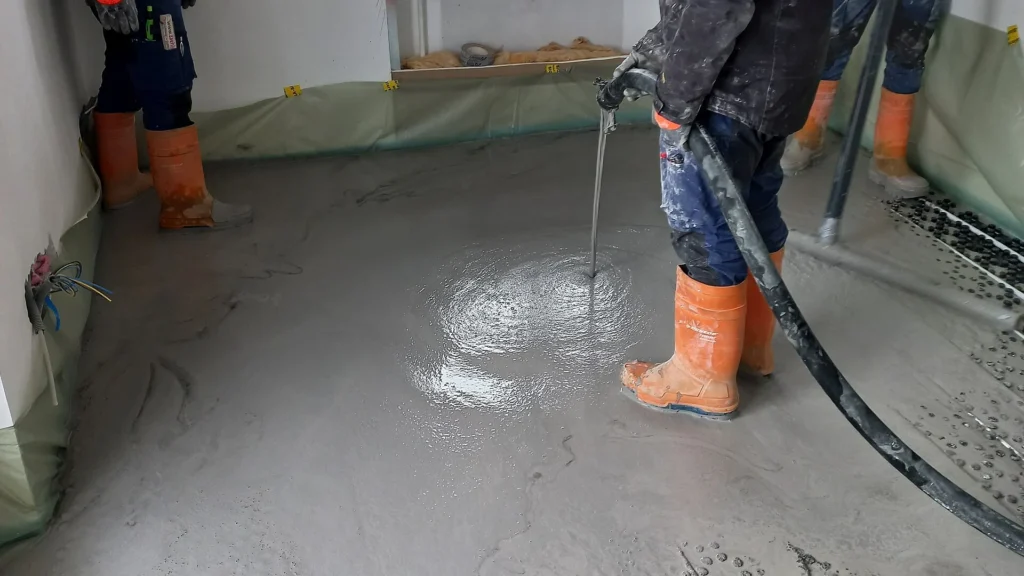
Workers pouring self-levelling screed over a floor from a hose

The subfloor is where most squeaks start

A squeak sounds as if it comes from the hardwood or laminate, but the flooring is usually just the thing transmitting the noise. Underneath it sits the subfloor, either boards or sheet panels, fastened down onto the joists that carry the whole structure. In houses built before about the mid-1950s that subfloor is commonly tongue-and-groove plank, often laid diagonally across the joists. Plywood became the standard after the Second World War, and oriented strand board is the usual panel today. What matters is not the material so much as the fastening. Nails are still allowed for fastening a subfloor, and glue between joist and subfloor is what adds stiffness and cuts squeaks. A nail holds a panel down without drawing it tight against a joist that sits slightly proud or slightly low, so a small gap can be there from day one. Every time somebody walks across it the panel flexes into and out of that gap, working against the smooth shank of the nail. That rubbing is the squeak, and it is why fixing the flooring above rarely holds.
What a subfloor squeak is, connection by connection

The first three are fastening problems. Joist movement and a delaminated panel can need more than a fastener, and the last one is fixed at the duct or hanger.

A gap at the joist

The subfloor panel does not sit flat on the joist, leaving a small space that opens and closes underfoot.

A nail that has stopped gripping

The smooth shank of a nail rubs against the panel as it flexes, rather than holding it still.

A fastener that missed the joist

A nail or screw that went in beside the joist instead of into it holds nothing, and the panel above it is free to move.

Joist movement

Framing that has shrunk, twisted or settled since the subfloor was laid, changing how the panel bears on it.

Delaminated panel

Occasionally the panel itself has separated in layers, in which case refastening alone will not solve it.

Something else rubbing the framing

Heating ducts without clearance, and joists sitting badly in metal hangers, also make floors squeak. We check for these from below.

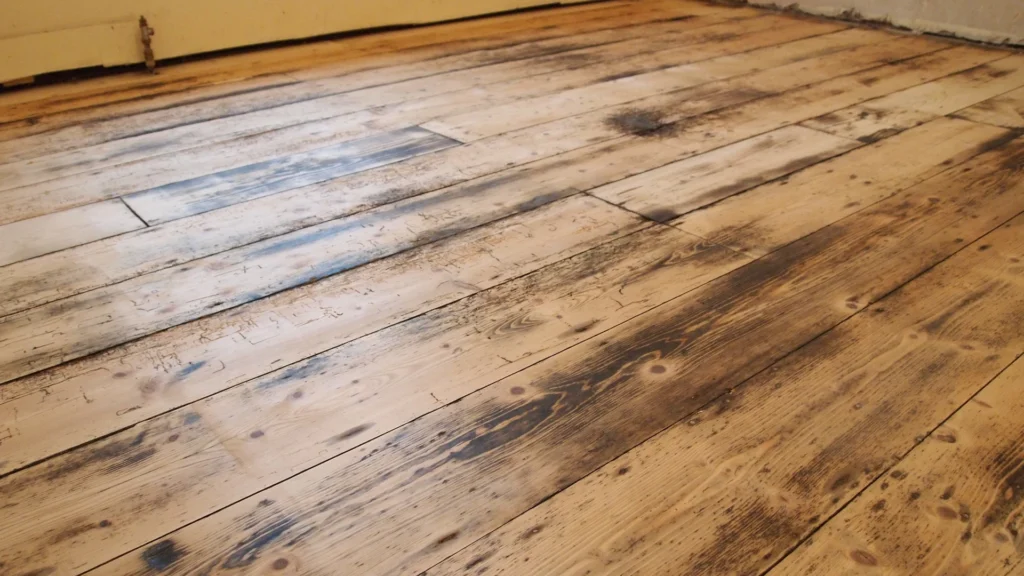
Old pine floorboards with dark stains and worn patches
From below and from above

How a loose subfloor is drawn back to the joist

From below is the first choice whenever the joists can be reached, because the finished floor is never touched. With someone walking above, the loose spot shows itself: the panel moves on the top of the joist, or a nail shifts in its hole. A thin gap at one joist is closed with a glue-coated shim tapped in until snug and no further, since forcing it lifts the floor above. A longer gap along the joist gets a bead of construction adhesive in the seam. Where a panel edge or plank end has nothing solid under it, a block or cleat is glued and screwed to the joist tight against the underside of the subfloor so the loose section bears on it. Any screw driven up from below has to stop at least 1/4 inch (6 mm) short of the floor surface. In a plank subfloor each board is fastened separately, so the fix is often one board refastened at each joist it crosses. From above, a screw is driven through the flooring and subfloor into the joist: a snap-off screw under carpet, a countersunk and filled trim-head screw under hardwood. A panel that has delaminated, or one softened by water, is replaced rather than refastened.

How we repair a squeaky subfloor

Locate the joist line

We find where the joists run and where the panel is losing contact, because guessing wastes fasteners and finish.

Close the gap properly

The aim is to draw the subfloor tight to the joist, not to add another fastener beside the one that failed.

Load-test the repair

We walk the area under real weight afterwards, because a floor can be quiet when empty and still squeak under load.

What squeaky subfloor repair typically costs

A gap closed from below sits toward the low end. Work through a finished floor, several areas, or a panel that has to be replaced sits higher, so the written quote matters here.

Larger Subfloor Work

$1,000 to $3,500 typical

Multiple areas or access through the finished floor
Includes reinforcement where the joist bearing has changed
Full scope walkthrough before starting

Get a Free Quote
Our Process

From your call to a solid subfloor

1

Describe what you feel

Not just the noise. Whether the floor moves, dips or feels springy matters more than the sound.

2

We ask about access below

An unfinished basement changes the job entirely compared with a finished ceiling or a second storey.

3

Scope and price in writing

Subfloor work varies, so we confirm exactly what is included before starting.

4

Repaired and load-tested

We close the gap, walk it under weight, and tell you what we found underneath.

Clients on floors that moved underfoot

5/5

We hired them to fix squeaking and movement in our hardwood floor. They identified the underlying problem quickly and completed the repair without needing to replace the entire floor. Everything now feels solid and quiet.

Jennifer

Direct Client

5/5

We needed an urgent flooring repair after several boards became loose and uneven. The team responded quickly, secured the boards, and corrected the uneven sections. Professional service and a high-quality repair from start to finish.

Robert

Direct Client

5/5

They repaired several damaged hardwood boards in our living room and blended the replacements beautifully with the existing floor. The team was punctual, tidy, and careful throughout the job. You can barely tell where the damage was.

Michael

Direct Client

Squeaky subfloor repair questions

How do we know the problem is the subfloor and not the flooring?

By finding where the movement is, ideally from below. With one person walking and another watching from the basement, a subfloor squeak shows as the panel or plank moving on the top of a joist, or a nail shifting in its hole, and it often comes with a slight sense of movement underfoot. A flooring squeak is a sharper tick at one board or seam with nothing moving underneath. We confirm it on site rather than guessing, because the two need different repairs.

Is it true that subfloor adhesive prevents squeaks?

Glue plus screws does a substantially better job than nails alone, because adhesive fills the small gaps where a panel does not sit perfectly flat on a joist and stops the two surfaces working against each other. Adhesive is standard construction practice rather than an Ontario Building Code requirement, so a newer home is not automatically squeak-free.

Can you repair a subfloor without removing our flooring?

In most cases, yes, and it is the preferred approach. Where the joists are reachable from a basement or crawlspace, we work from below and the finished floor is never touched. Where they are not, there are from-above methods that go through the flooring at a very small, repairable point. Removing flooring is reserved for genuine panel damage.

Our floor feels springy as well as squeaky. Is that the same problem?

It is related but more significant, and worth having looked at. A squeak is a connection issue; a springy or soft area suggests the panel or the joist beneath it is not providing the support it should, whether from damage, moisture, or a span that was marginal to begin with. We will tell you which of the two you have.

Does it matter whether our subfloor is plank, plywood or OSB?

It affects the method more than the outcome. Plank subfloor in older houses is usually diagonal boards nailed to sawn joists, and each board is fastened separately. Plywood and oriented strand board are sheet goods, so a single panel spans several joists and one bad bearing point can produce noise across a wider area. We identify which you have before deciding how to fasten it.

Our house has engineered I-joists. Can a squeaky subfloor still be fixed?

Yes, with one rule that does not apply to sawn lumber: the flanges of an I-joist are never cut, drilled or notched. So the repair uses construction adhesive and glued shims at the top flange, or screws from above into the top flange where the subfloor fasteners already go. Nothing is cut into the joist. If an I-joist floor feels bouncy rather than just noisy, that is a span or support question and we would tell you so.

Convinced it is the floor when it is really the subfloor?

Get a free written quote to find the joist connection that has separated and close it properly.

Back to top