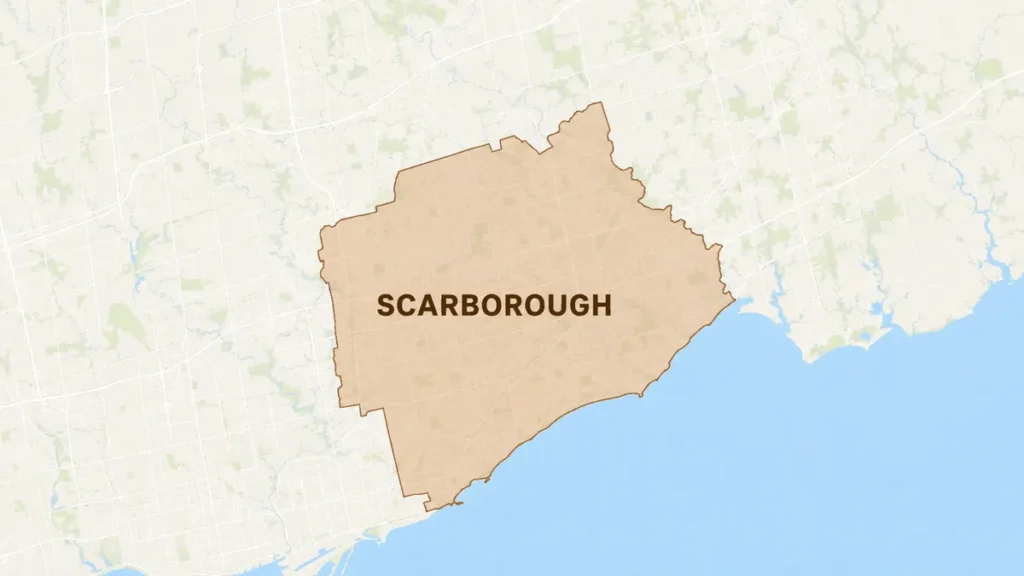
Scarborough: a postwar boom with one older corner
Most Scarborough houses date from one short, fast boom. When the township was established in 1850 it had about 3,000 people; between 1950 and 1955 the population doubled from 48,000 to 110,000, then tripled again by 1970, and the pace picked up after Highway 401 opened in 1956 (City of Toronto Archives, Scarborough Civic Centre exhibit). The farms became subdivisions of single family homes and apartment blocks, and by 1970 little of the rural township remained. The era-typical floor in those houses is plywood subfloor nailed to dimensional joists, now 55 to 75 years into seasonal movement.
Cliffside is a typical example: a large-scale subdivision of the early 1950s, built on subdivided farmland, with the area south of Kingston Road on a former golf course. Birch Cliff is the exception. It was the first part of Scarborough developed as a suburb, as a streetcar suburb along Kingston Road in the 1920s, while the rest was built after the Second World War around the car. Its floors are a generation older and more likely to be plank.