Craftsman and Foursquare houses Free diagnostic visit Written quote before work

Squeaky floor repair in Old Ottawa South

Squeaky Floor refastens loose floors and stairs in Old Ottawa South, the former police village of Rideauville between the Rideau Canal and the Rideau River, where most houses are Craftsman and Foursquare homes of the 1920s and 1930s.

Get a Free Quote for Your Home

Tell us about your project and we will get back to you within 24 hours.

What can we help with?

So the right crew reviews your project.

No obligation. We reply within one business day.

Old Ottawa South housing, explained

Foursquare and Craftsman houses, and what that means underfoot

Old Ottawa South grew fast once the streetcar reached it around 1910. The area was settled around 1814, became the police village of Rideauville in 1905 and joined Ottawa in 1907. What it built over the next decades is mostly Craftsman housing, with many American Foursquare houses of the 1920s and 1930s. Both typically have strip hardwood over board subfloor nailed to sawn joists, now close to a hundred years old. In the Old Ottawa South census tract, 68.6 per cent of dwellings predate 1961 and only 12.4 per cent were built after 2000 (Statistics Canada, 2021 Census Profile), so most houses still have their original floor structure. Many have been upgraded or added to over the years, and the joint where a newer addition meets the original floor is one place a newer squeak can start.
What we fix in Old Ottawa South homes

Foursquare floor geometry

Bedrooms directly over living rooms, so every step upstairs is heard below.

The main stair

Close to a century of daily traffic on original treads, risers and wedges.

Additions meeting old floors

The seam where a newer floor joins the original boards, where a newer squeak can start.

From one of our repairs

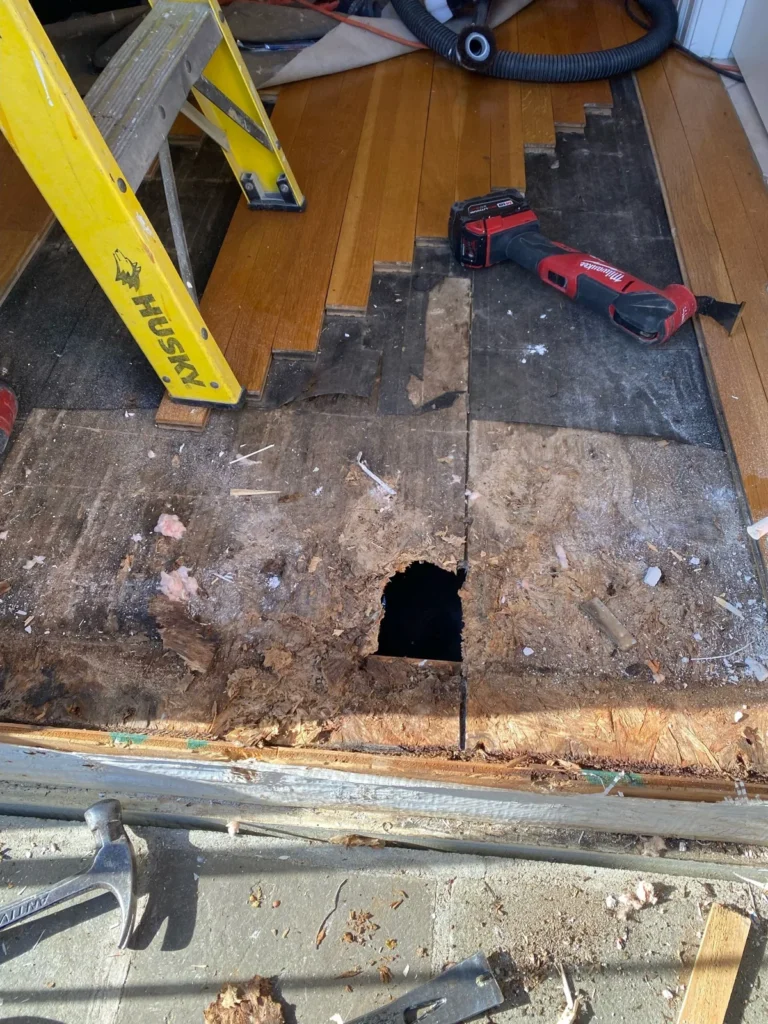
Opening the floor beside the stairs

Here the hardwood at the foot of a staircase was cut back in a stepped line to reach a damaged section of subfloor, without lifting the whole floor. Around an Old Ottawa South main stair, the same approach lets the floor next to the stair be repaired while the rest stays down.

Working on an Old Ottawa South house

One era, one likely floor system

Most houses here date from the same decades, so the likely subfloor is known before we arrive, then confirmed.

Strip hardwood refastened in place

Loose boards are fastened back down rather than lifted and replaced.

Honest scope

If three fasteners fix it, the quote is for three fasteners.

What an Old Ottawa South squeak repair costs

A loose board in a Foursquare bedroom, or one noisy tread on the main stair, sits in the middle tier. A whole floor loose across its joists, or an addition junction that needs the subfloor opened, moves to the subfloor tier. Both paid tiers are budgeting ranges, so expect your own figure in the written quote.

Diagnostic Visit

Free

We find the moving board, tread or junction
We check the stair from below where it is open
The cause explained, free

Request a Visit

Whole-Room or Subfloor Work

$1,000 to $3,500 typical

A full bedroom floor or an addition junction
Old and new subfloor joined and fastened
Walked with you before it is quoted

Get a Free Quote
Our Process

How a squeak in an Old Ottawa South house gets fixed

1

Floor, stair or addition?

Tell us where it squeaks, and whether that part of the house is original or added later.

2

Find the joint that moves

The floor or stair is walked while the spot is located and marked.

3

Price agreed in writing

You see the scope and the price on paper before work starts.

4

Refasten, re-wedge, re-walk

Boards are screwed or shimmed to the joist, stair joints re-wedged and glue-blocked, then walked again.

Customer reviews for Old Ottawa South homeowners

5/5

We hired them to fix squeaking and movement in our hardwood floor. They identified the underlying problem quickly and completed the repair without needing to replace the entire floor. Everything now feels solid and quiet.

Jennifer

Direct Client

5/5

We needed an urgent flooring repair after several boards became loose and uneven. The team responded quickly, secured the boards, and corrected the uneven sections. Professional service and a high-quality repair from start to finish.

Robert

Direct Client

5/5

They repaired several damaged hardwood boards in our living room and blended the replacements beautifully with the existing floor. The team was punctual, tidy, and careful throughout the job. You can barely tell where the damage was.

Michael

Direct Client

Old Ottawa South floor and stair questions

What makes Old Ottawa South houses particularly prone to floor noise?

The common house form. The Foursquare plan found throughout the neighbourhood is a boxy two-storey house that puts bedrooms directly over the living rooms, so every step upstairs loads a joist that somebody is sitting under. Over a nailed board subfloor that has dried and swelled through decades of Ottawa winters, that layout carries the noise of each loose board straight to the room below.

Why does the main stair in our Old Ottawa South house squeak?

Because it carries every trip between floors. A Foursquare has four rooms on each level and one main stair joining them, so all the traffic between the bedrooms and the living rooms crosses the same treads. The noise starts at the joints where treads, risers and stringers meet, once the wedges and nails holding them have shrunk and loosened. Those joints can be refastened and re-wedged in place, so the original stair stays.

Is our Old Ottawa South house likely to still have its original floor?

Yes, in most cases. In the Old Ottawa South census tract, 68.6 per cent of dwellings were built before 1961 and 78.4 per cent before 1981, while only 12.4 per cent date from after 2000. Most houses are the original Craftsman and Foursquare homes, likely with their original floors still in place, so the starting point is refastening the boards you have rather than replacing them.

Our Old Ottawa South house has an addition. Why does the floor squeak where it meets the old part?

Because two floor systems meet there. The original house typically has board subfloor on sawn joists that have had a century to dry out; the addition has newer joists and sheet subfloor, and new lumber shrinks in its first years. Where the two are joined, a small difference in height or movement can open a gap at a joist or a seam. The fix is to shim and fasten that junction, from below where it can be reached.

Squeaky floors or stairs in Old Ottawa South?

The diagnostic visit is free. You find out which board or stair joint is loose, and what it costs to fix, before deciding.

Back to top