Late-1940s postwar houses Free diagnostic visit Written quote before work

Squeaky floor repair in Manor Park

Squeaky Floor tracks down and repairs floor and stair squeaks in Manor Park, Ottawa’s first postwar subdivision, where the first families moved in during 1947 and most houses date from the late 1940s and early 1950s.

Get a Free Quote for Your Home

Tell us about your project and we will get back to you within 24 hours.

What can we help with?

So the right crew reviews your project.

No obligation. We reply within one business day.

Manor Park housing, explained

Late-1940s houses, now nearly eighty years old

Manor Park was built in one push after the Second World War. A small mid-1920s development called Rockcliffe Annex already stood on the site; Manor Park was laid out over it, the first families moved in during 1947, and the press of the day called it Canada’s first completely co-ordinated community. The great majority of its houses date from the late 1940s and early 1950s and were built by a consortium of five Ottawa-area developers. That timing puts them at the switch from board to plywood subfloor, and either one was typically nailed rather than glued. Close to eighty Ottawa heating seasons later, those nailed connections have had a long time to work loose. Cardinal Glen is the exception: Timberlay Homes began building it in 1988, so its houses are about forty years younger, with a different floor system.
What we fix in Manor Park homes

Late-1940s and 1950s floors

Nailed subfloor that has worked through decades of seasonal shrinking and swelling.

Five builders, one era

Houses from five developers can differ in subfloor and fastening, so we confirm yours.

Cardinal Glen homes

Checked for missed fasteners and panel gaps, not just age.

From one of our repairs

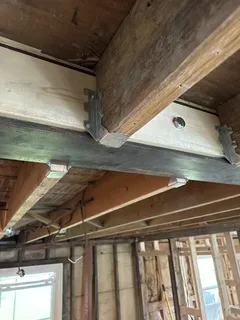
An older joist in a new hanger

Here an original joist sits in a new metal hanger on a newer beam, with the older wood kept in place. Manor Park houses came from five builders in the late 1940s and 1950s, so the framing under one house can differ from the next, and it is confirmed before a repair is planned.

How we handle a Manor Park floor

We date the specific house

An original Manor Park house and a Cardinal Glen home have two different floor systems.

Basement access used where available

Working from below leaves the finished floor untouched.

Written quote, then the work

Scope and price in writing. Any workmanship warranty is set out in that quote.

What a Manor Park squeak repair costs

In an original Manor Park house, one loose board or plywood sheet over one joist sits in the middle tier, often reachable from the basement. A whole main floor loose across its joists moves to the subfloor tier. A Cardinal Glen squeak is more often a single missed fastener. Use the ranges for budgeting; the written quote gives your actual price.

Diagnostic Visit

Free

We find the moving joint, from below where it is open
We confirm board or plywood subfloor
Free, with nothing to book after

Request a Visit

Whole-Room or Subfloor Work

$1,000 to $3,500 typical

A main floor loose across many joists
Finished basement ceilings may need opening
Room-by-room scope in the written quote

Get a Free Quote
Our Process

How a Manor Park repair runs

1

Original house or Cardinal Glen?

Tell us which, and the build year if you know it.

2

Trace the moving joint

From the basement where the ceiling is open, confirming board or plywood at the same time.

3

Quote on paper

Scope and price in writing before work starts.

4

Fix and re-walk

Boards are refastened one by one, plywood sheets drawn down to the joist, and the floor walked again.

Customer reviews for Manor Park homeowners

5/5

We hired them to fix squeaking and movement in our hardwood floor. They identified the underlying problem quickly and completed the repair without needing to replace the entire floor. Everything now feels solid and quiet.

Jennifer

Direct Client

5/5

We needed an urgent flooring repair after several boards became loose and uneven. The team responded quickly, secured the boards, and corrected the uneven sections. Professional service and a high-quality repair from start to finish.

Robert

Direct Client

5/5

They repaired several damaged hardwood boards in our living room and blended the replacements beautifully with the existing floor. The team was punctual, tidy, and careful throughout the job. You can barely tell where the damage was.

Michael

Direct Client

Manor Park and Cardinal Glen floor questions

How old is Manor Park housing?

The core of it is late 1940s and early 1950s. Manor Park was built over the mid-1920s Rockcliffe Annex, and the first families moved in during 1947. Unless a house has been rebuilt, or sits in the later Cardinal Glen pocket, it is likely to date from those first postwar years.

Is a late-1940s Manor Park house built the same way as a 1930s house?

Not quite, and the difference matters here. The late 1940s sit at the transition from board subfloor to plywood sheet subfloor, so Manor Park houses can have either depending on exactly when and by which of the five builders they were built. Both were typically nailed rather than glued and screwed, which is the shared reason they loosen, but boards are refastened one by one while a plywood sheet is drawn down to the joist, so we confirm which one you have first.

Our Manor Park house is in Cardinal Glen. Is it too new to squeak?

No, but the reason would be different. Timberlay Homes began building Cardinal Glen in 1988, which makes the oldest houses there close to forty years old, typically on plywood or early OSB subfloor. Squeaks there tend to come from a fastener that missed a joist or a panel seam that was never drawn tight, rather than from decades of accumulated seasonal movement.

Squeak in a postwar Manor Park house?

Tell us whether it is an original house or Cardinal Glen, and book a free diagnostic visit. The quote comes in writing.

Back to top