Postwar subdivisions Free diagnostic visit Written quote before work

Squeaky floor repair in Nepean

Squeaky Floor repairs squeaky floors and stairs in older Nepean, a group of mostly postwar subdivisions with recorded build years, from Carleton Heights around 1950 to Parkwood Hills, finished in 1972.

Get a Free Quote for Your Home

Tell us about your project and we will get back to you within 24 hours.

What can we help with?

So the right crew reviews your project.

No obligation. We reply within one business day.

Nepean housing, explained

Postwar subdivisions with known build dates

In older Nepean you can usually tell roughly when a house was built from the subdivision it sits in. Carleton Heights was built for veterans under the Veterans’ Land Act, with most homes not built until around 1950, as small houses on large lots. Bel-Air Park’s homes were all built between 1956 and 1958 by Campeau, and Bel-Air Heights followed in 1959 and 1960. Copeland Park’s first house went up in 1956. Parkwood Hills was planned by architect John Russell in 1959 and built out between 1959 and 1972, largely by Minto, with many singles of around 1,200 square feet. City View’s homes were built mostly from the 1930s to the 1960s. Plywood became the standard subfloor after the war, so most of these houses typically have plywood sheets nailed to dimensional joists; City View’s older houses and the earliest Carleton Heights homes can still have boards laid diagonally across the joists. Little of it has been replaced: in the Carleton Heights census tract, 80.6 per cent of homes predate 1981 and only 2.6 per cent were built after 2000 (Statistics Canada, 2021 Census Profile). Barrhaven, part of the City of Nepean until 2001, is a different case: it was established in the 1960s and most of its growth came later.
What we fix in Nepean homes

Nailed 1950s plywood

The 1950s to early 1970s standard across Bel-Air, Copeland Park and Parkwood Hills.

Small Carleton Heights houses

Small veterans' houses on large lots, most of them built around 1950.

City View's older houses

Homes from the 1930s onward, some still on diagonal board subfloor.

From one of our repairs

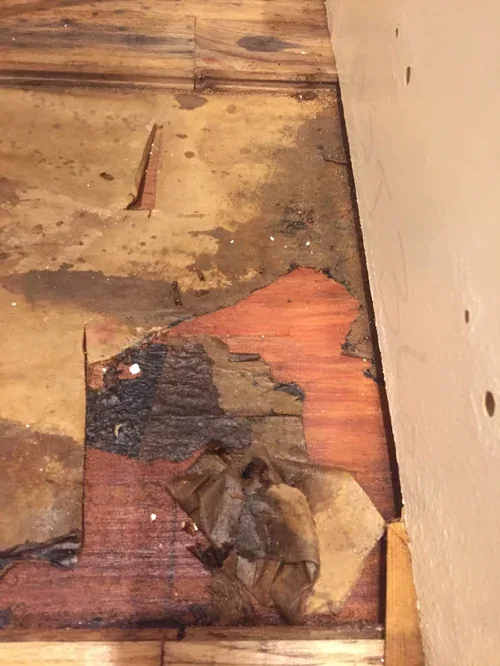
Checking the subfloor after a leak

With the flooring lifted along this wall, the subfloor underneath shows water staining and torn underlay. Before any flooring goes back down, the subfloor is checked with a moisture meter and either dried or replaced, which helps keep the problem from coming back.

How we approach an older Nepean house

Tight build dates help diagnosis

When a subdivision went up in two or three years, the floor assembly is likely to be consistent.

Basement access used where possible

Working from below leaves the finished floor untouched.

We fix what is making the noise

No package deals, no extras you did not ask about, and the price in writing first.

What a Nepean squeak repair costs

In a Bel-Air Park or Parkwood Hills house with an open basement ceiling, a squeak is often one plywood sheet off one joist, fixed from below in the middle tier. An older City View house with diagonal board subfloor loose across a room, or a finished basement ceiling that has to be opened, moves to the subfloor tier. Ranges are for budgeting; the written quote is the binding figure.

Diagnostic Visit

Free

We find the sheet or board that moves
We match the house to its subdivision's build years
No charge, no obligation

Request a Visit

Whole-Room or Subfloor Work

$1,000 to $3,500 typical

A room of loose diagonal boards, or a full floor
Opening a finished basement ceiling, if there is one
Quoted after an on-site walkthrough

Get a Free Quote
Our Process

How a Nepean floor repair runs

1

Tell us the subdivision

Bel-Air Park, Copeland Park, Parkwood Hills, City View or Carleton Heights, and the year if you know it.

2

Check from the basement

We confirm plywood or diagonal boards and find the joint that moves.

3

Scope agreed in writing

You get the scope and price in writing before any work.

4

Fix from below, re-walk

Plywood is drawn down to the joist, diagonal boards are fastened one at a time, and the floor is walked again.

Customer reviews for Nepean homeowners

5/5

We hired them to fix squeaking and movement in our hardwood floor. They identified the underlying problem quickly and completed the repair without needing to replace the entire floor. Everything now feels solid and quiet.

Jennifer

Direct Client

5/5

We needed an urgent flooring repair after several boards became loose and uneven. The team responded quickly, secured the boards, and corrected the uneven sections. Professional service and a high-quality repair from start to finish.

Robert

Direct Client

5/5

They repaired several damaged hardwood boards in our living room and blended the replacements beautifully with the existing floor. The team was punctual, tidy, and careful throughout the job. You can barely tell where the damage was.

Michael

Direct Client

Questions about older Nepean houses

How can you tell what year a Nepean house was built?

Start with the subdivision. Most older Nepean streets belong to a named subdivision with a recorded build window: Bel-Air Heights went up mostly in 1959 and 1960, for example, and Copeland Park's first house was built in 1956. Knowing the window narrows the likely subfloor construction before we arrive, and a look at the subfloor from the basement confirms it.

Are the small Carleton Heights houses in Nepean harder to repair?

No, usually easier. Many were built for veterans under the Veterans' Land Act around 1950 as small houses on large lots, which in most cases means shorter joist spans. Less span means less deflection and a more contained search for the connection that is moving.

Is a Parkwood Hills house in Nepean built differently from one in Bel-Air Park?

Mainly in timing and builder. Bel-Air Park went up in one short run, between 1956 and 1958, built by Campeau. Parkwood Hills was built over thirteen years, from 1959 to 1972, largely by Minto, and many of its singles are around 1,200 square feet. Both are postwar houses typically on nailed plywood, but they were built by different firms over different years, so we confirm the floor in your house rather than assume it matches the other.

Is Barrhaven housing as old as the rest of Nepean?

No. Barrhaven was part of the City of Nepean until amalgamation in 2001, but modern Barrhaven was only established in the 1960s, and its large growth followed a 1979 provincial cabinet decision that overturned a limit on its expansion. Its houses span from the 1960s to recent years, so a squeak there depends on the build year more than the address. Tell us the year when you call.

Squeak in a postwar Nepean house?

Name your subdivision and book a free diagnostic visit. The scope and price come in writing before any work.

Back to top