Crown Point to Westdale Serving Hamilton Free written quotes

Squeaky floor repair in Hamilton

Squeaky Floor repairs squeaking floors and stairs in Hamilton by finding the loose plank, nail or joist connection and fastening it back down.

In the 2021 census, 32.8 per cent of Hamilton’s dwellings were built in 1960 or earlier, against 22.7 per cent across Ontario.

Get a Free Quote for Your Home

Tell us about your project and we will get back to you within 24 hours.

What can we help with?

So the right crew reviews your project.

No obligation. We reply within one business day.

Hamilton by the census

A third of the city built by 1960

Hamilton’s housing is older than Ontario’s as a whole. The City’s December 2023 Housing Needs Assessment, using 2021 census data, puts 32.8 per cent of Hamilton dwellings at 1960 or earlier against 22.7 per cent province-wide, and only 18.3 per cent at 2001 to 2021 against 26.1 per cent (City of Hamilton, Housing Needs Assessment, December 2023). Wards 3 and 4 are older again, at 74.5 and 72.3 per cent built by 1960. Crown Point is documented down to the survey: J. Walter Gage registered the Kensington survey in 1912, and the area’s school buildings date from 1911 to 1923. Westdale’s name was chosen in March 1923, most residents arrived between 1925 and 1930, and it was largely complete by 1931; in the 2021 census, 45.0 per cent of dwellings in the L8S postal area, which covers Westdale, Ainslie Wood and the McMaster lands, were built in 1960 or earlier (Statistics Canada, 2021 Census Profile). Durand was built out from the 1850s to the 1930s. All three predate plywood as the standard subfloor, so a squeak there usually starts in plank boards nailed to sawn joists. The newest housing is elsewhere: in Ward 11, which is mostly the former Glanbrook including Binbrook and Mount Hope, 59.6 per cent of dwellings were built between 2001 and 2021.
Hamilton floors by neighbourhood era

Crown Point, 1911 to 1923

Pre-war and early 1920s houses on plank subfloor, often laid diagonally, now about a century old.

Westdale's planned decade

Built mostly between 1925 and 1931, so floors across the neighbourhood share one build era.

Durand's older core

Houses from the 1850s to the 1930s, built before plywood, on board subfloor over sawn joists.

From one of our repairs

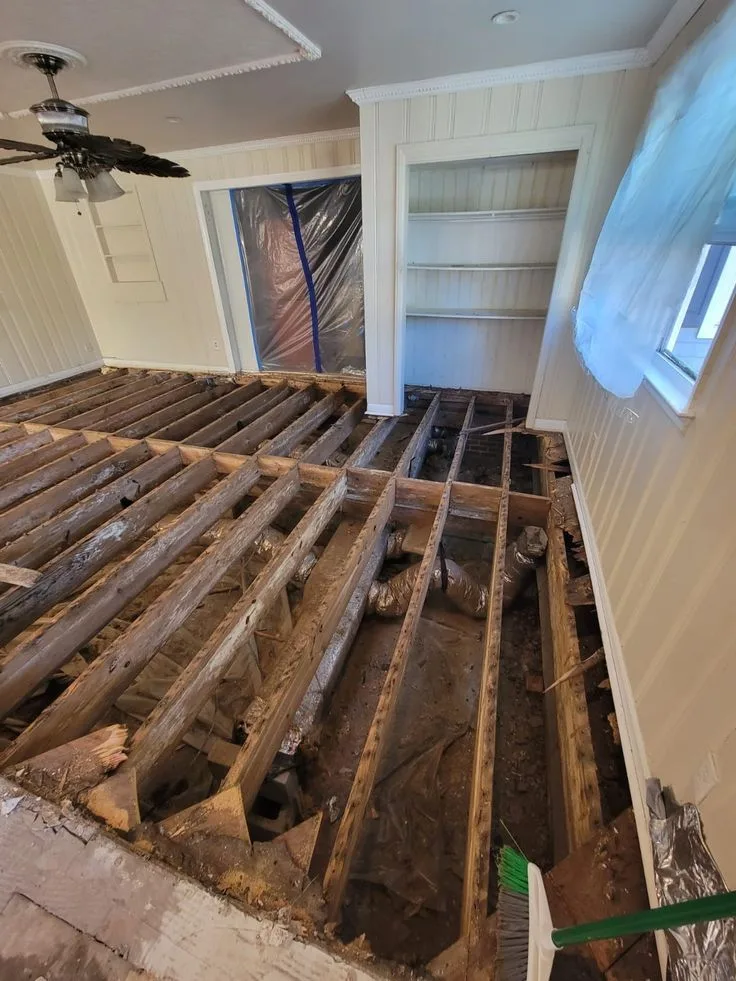
Old joists, uncovered

This room’s floor has been taken up to the joists, leaving the whole frame open to inspect. In Hamilton neighbourhoods like Durand and Crown Point, where houses are about a century old or more, the board subfloor over joists like these has had decades to loosen.

How a Hamilton repair is planned

The build year sets the method

A 1912 Crown Point house and a 2010 Binbrook house have different floor systems, so we ask the year before we quote.

Plank subfloor is fixed board by board

Each loose plank is shimmed or screwed to its joist; there is no single panel to re-fasten as there is with plywood.

From below when the basement is open

With an open basement ceiling, shims, blocking and screws go in from underneath and the hardwood above is not touched.

Damage listed on its own

In 2021, 6.6 per cent of Hamilton dwellings needed major repairs against 5.7 per cent in Ontario; if the visit finds rot or a cracked joist, the quote shows it as a separate item.

Our nearest office to Hamilton

The nearest Squeaky Floor office to Hamilton is our Toronto office at 4544 Sheppard Avenue East in Agincourt South-Malvern West. Call to book a free diagnostic visit, and the crew comes to your house in Hamilton for the visit and the repair.

Squeaky floor repair prices in Hamilton

Your price depends on the floor system and how we reach it, and the written quote after the free visit sets it. In a Hamilton house built before 1961, plank subfloor under an open basement ceiling is usually quicker to reach than plank under a finished basement or a plaster ceiling.

Diagnostic Visit

Free

We find the squeaking plank and the joist under it
In person, or a first read from photos
The cause explained, with no obligation

Request a Visit

Whole-Room or Subfloor Work

$1,000 to $3,500 typical

A whole room of loose plank, or several rooms
May need access through a ceiling below
Scope walked with you before quoting

Get a Free Quote
Our Process

From first call to a quiet Hamilton floor

1

Tell us the street and the year

Give the neighbourhood and, if you know it, when the house was built. A 1928 Westdale house points to plank subfloor before we arrive.

2

Free diagnostic visit

We walk the floor, mark where it moves, and check from the basement if the joists are exposed.

3

Shims, blocking or screws, in writing

The quote names the fix, whether shims, blocking or screws, and the price, before any work starts.

4

Repair and re-walk

After the repair we walk the same boards again with you to confirm the squeak has stopped.

Reviews on repairing rather than replacing

5/5

We hired them to fix squeaking and movement in our hardwood floor. They identified the underlying problem quickly and completed the repair without needing to replace the entire floor. Everything now feels solid and quiet.

Jennifer

Direct Client

5/5

We needed an urgent flooring repair after several boards became loose and uneven. The team responded quickly, secured the boards, and corrected the uneven sections. Professional service and a high-quality repair from start to finish.

Robert

Direct Client

5/5

They repaired several damaged hardwood boards in our living room and blended the replacements beautifully with the existing floor. The team was punctual, tidy, and careful throughout the job. You can barely tell where the damage was.

Michael

Direct Client

Questions about Hamilton floors

Why do older Hamilton houses squeak?

Because their plank subfloor has moved with the seasons for 65 years or more. In the 2021 census, 32.8 per cent of Hamilton dwellings were built in 1960 or earlier, against 22.7 per cent across Ontario. Houses built before the mid-1950s usually have softwood plank subfloor, often laid diagonally across the joists, and plywood only became the standard after the Second World War. Each heating season dries the joists and each humid summer swells them again, and that movement slowly works the smooth-shank nails loose until wood rubs on nail or board on board.

How old is Crown Point housing in Hamilton?

Much of it dates from the 1910s and early 1920s. J. Walter Gage registered the Kensington survey covering part of Crown Point in 1912, and the area's school buildings date from 1911 to 1923, which brackets the build-out. Floors from that era are plank subfloor nailed to sawn joists, now around a hundred years old.

Is Westdale different from the rest of Hamilton?

Yes: it was built in one planned decade. Westdale's name was chosen in March 1923, most residents arrived between 1925 and 1930, and the neighbourhood was largely complete by 1931. In the 2021 census, 45.0 per cent of dwellings in the L8S postal area, which covers Westdale, Ainslie Wood and the McMaster lands, were built in 1960 or earlier, and another 34.2 per cent from 1961 to 1980. It is a little later than Crown Point and considerably later than Durand.

Squeaky floor in an older Hamilton house?

Arrange the free diagnostic visit. Tell us the street and the year the house was built, and the written quote follows the visit.

Back to top