Late-1930s to 1950s houses Serving Leaside Free written quotes

Squeaky floor repair in Leaside

Squeaky Floor finds and fixes the loose board, fastener or subfloor connection making the noise in Leaside homes. Leaside was planned by Frederick Todd and incorporated as a town in 1913, but it had only 938 residents in 1931 and 16,233 by 1951, so most of its houses date from the late 1930s to the 1950s.

Get a Free Quote for Your Home

Tell us about your project and we will get back to you within 24 hours.

What can we help with?

So the right crew reviews your project.

No obligation. We reply within one business day.

Leaside, 1913 to the 1950s

Leaside: a 1913 plan with postwar houses

Most Leaside houses are decades younger than its street plan. A subsidiary of the Canadian Northern Railway developed the town to a design by Frederick Todd, it was incorporated in 1913, and many of its streets are named for railway executives. Industry came first: Todd reserved the southeast quarter for it, and 52 companies were in place by the end of the 1930s. Housing lagged. The population was 938 in 1931, 6,183 in 1941 and 16,233 in 1951, and residential building only came in full after the Second World War, as single-family homes on narrow, curving streets and culs-de-sac. For floors, that places most Leaside houses between the late 1930s and the 1950s, when plywood was replacing plank as the standard subfloor but was still nailed down rather than glued. A nail holds a panel in place without drawing it tight to a joist that is slightly out of plane, and that small gap is where the noise starts decades later.
What we fix in Leaside homes

Nail-held plywood subfloor

Postwar panels held by nails alone, now seventy years into seasonal movement.

Late-1930s and early-1940s plank

Houses built before plywood took over can still sit on diagonal plank subfloor, which is refastened board by board.

Heating-season noise

Squeaks that appear once the furnace runs and ease off in spring as indoor humidity swings.

From one of our repairs

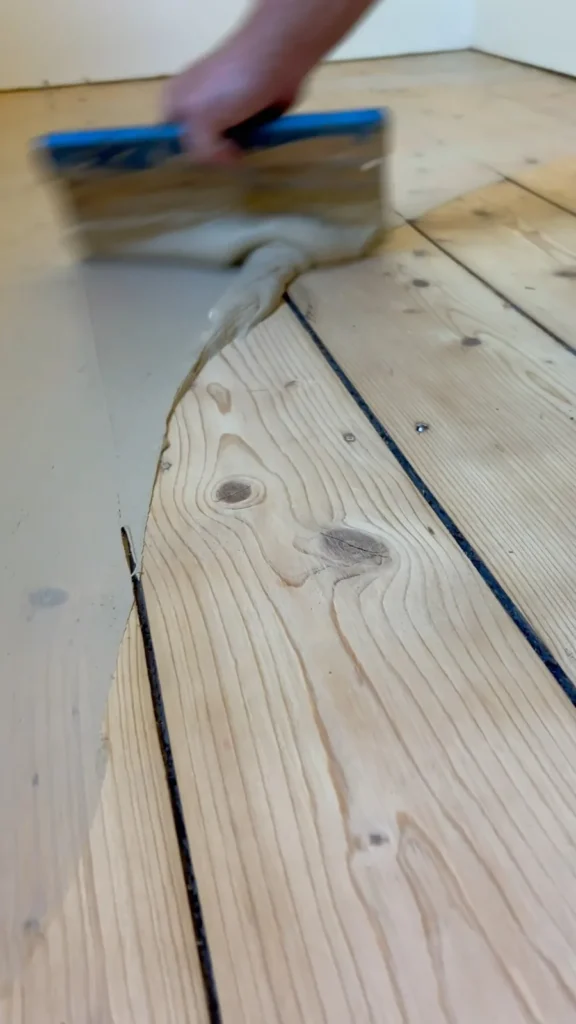
Filling the gaps between old pine boards

Filler is pressed into the gaps between these wide pine boards with a broad knife, closing the seams between them. In Leaside’s older houses, gaps like these open up once the furnace runs and the indoor air dries out, and they ease off again in spring.

How we approach a Leaside floor

We check plank or panel first

We confirm which subfloor you have before choosing a fix, because each one is repaired differently.

From the basement where it is open

A main-floor squeak can usually be fixed from below with shims or screws, leaving the finished floor alone.

Original hardwood kept

We refasten and repair. We do not sand, refinish or replace floors.

Quote in writing, every time

The visit is free, and scope and price are confirmed before we begin.

Our Toronto office, serving Leaside

Our Toronto office is at 4544 Sheppard Avenue East in Agincourt South-Malvern West. Call to book a free diagnostic visit, and the crew comes to your house in Leaside for the visit and the repair.

Leaside Squeaky Floor Repair Pricing

These are budgeting ranges; your written quote sets the price. A main-floor squeak in a postwar Leaside house over an open basement typically sits in the single-squeak tier. Upstairs bedrooms over finished ceilings, or a whole room of panels moving on their nails, move the job toward the whole-room tier.

Diagnostic Visit

Free

We confirm plank or plywood subfloor
We find the joist the noise sits on
No pressure to book anything after

Request a Visit

Whole-Room or Subfloor Work

$1,000 to $3,500 typical

Upstairs rooms over finished ceilings
Or panels loose across a whole room
Quote in writing before anything begins

Get a Free Quote
Our Process

How a Leaside squeak is found and fixed

1

Tell us where and when it squeaks

Which room, which floor, and whether it is louder in winter. A winter-only squeak in a postwar house points to a nailed panel.

2

We place it on a joist

On the free visit we find the noise from above and, where the basement is open, see whether a panel or a plank is moving against its nails.

3

Written scope and price

Scope and price in writing, including whether the fix is made from the basement or through the finished floor.

4

We fix it and re-test it

We draw the panel or plank tight to the joist, walk the section again to confirm the noise is gone, and explain what caused it.

What homeowners say about keeping their floor

5/5

We hired them to fix squeaking and movement in our hardwood floor. They identified the underlying problem quickly and completed the repair without needing to replace the entire floor. Everything now feels solid and quiet.

Jennifer

Direct Client

5/5

We needed an urgent flooring repair after several boards became loose and uneven. The team responded quickly, secured the boards, and corrected the uneven sections. Professional service and a high-quality repair from start to finish.

Robert

Direct Client

5/5

They repaired several damaged hardwood boards in our living room and blended the replacements beautifully with the existing floor. The team was punctual, tidy, and careful throughout the job. You can barely tell where the damage was.

Michael

Direct Client

Leaside squeaky floor questions

Leaside is called a 1913 community. Does that mean my floors are over a century old?

Almost certainly not. 1913 is the year the town was incorporated, not the date of the houses. Leaside had 938 residents in 1931 and 16,233 in 1951, so most homes went up from the late 1930s through the 1950s, and a typical floor here is roughly seventy to ninety years old, built differently from a pre-1914 house.

Is a 1940s Leaside house more likely to have plank or plywood subfloor?

It depends which side of the war it was built on. Plywood became the standard subfloor for new houses after the Second World War, so a Leaside house from the early 1940s is more likely to have plank subfloor, often 1×6 or 1×8 boards laid diagonally, while one from the later 1940s sits at the changeover from plank to plywood, so either is possible. If the basement ceiling is open, you can usually see which from below. It matters because a loose plank and a lifting panel are fixed in different ways.

Our postwar Leaside house only squeaks in winter. Is that the nailed plywood?

Very likely. When dry furnace-season air shrinks the joists, the small gap at a nailed panel opens and the panel rubs on the nail shank. That is real loosening, not just weather. The noise may fade when summer humidity returns, but the loose connection stays and the squeak usually comes back each winter. It is also easier to locate a noise we can reproduce on site, so a winter visit is usually more productive than a July one.

Have a squeak in your Leaside house?

Tell us roughly when the house was built and which room is noisy. The visit is free and the quote is in writing.

Back to top