The actual root cause Fixed from below where possible Free written quotes

Squeaky subfloor repair

Squeaky Floor repairs the subfloor connection that is the real cause of most squeaks: the panel or plank that has separated from the joist beneath your finished floor.

Fix the flooring and the noise comes back. Fix the subfloor connection and it does not.

Get a Free Quote for This Repair

Tell us about your project and we will get back to you within 24 hours.

What can we help with?

So the right crew reviews your project.

No obligation. We reply within one business day.

The subfloor is where most squeaks actually live

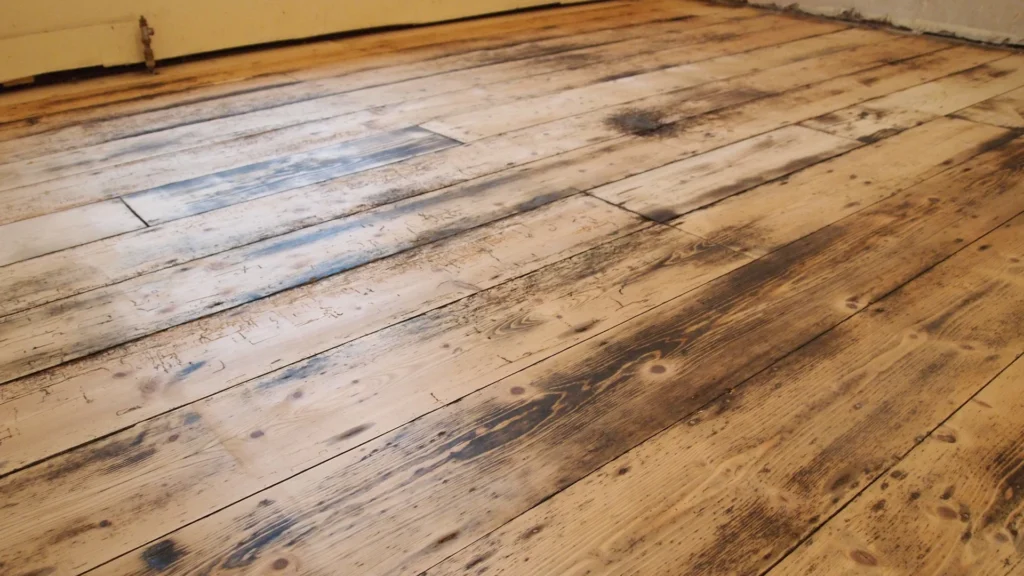
People call about a squeaky hardwood or laminate floor, but the flooring is usually just the thing transmitting the noise. Underneath it sits the subfloor, either boards or sheet panels, fastened down onto the joists that carry the whole structure. In older Ontario housing that subfloor is plank, often laid diagonally across the joists because that was how rigidity was achieved before sheet goods existed. From roughly the postwar period onward it is plywood, and later oriented strand board. What matters is not the material so much as the fastening: for decades the standard was nails, and a nail holds a panel down without drawing it tight against a joist that sits slightly proud or slightly low. That leaves a small gap from day one. Every time somebody walks across it the panel flexes into and out of that gap, working against the smooth shank of the nail. That rubbing is the squeak, and it is why fixing the flooring above rarely holds.
What a subfloor squeak actually is

The mechanism is the same across almost every house we work in.

A gap at the joist

The subfloor panel does not sit flat on the joist, leaving a small space that opens and closes underfoot.

A nail that has stopped gripping

The smooth shank of a nail rubs against the panel as it flexes, rather than holding it still.

A fastener that missed the joist

More common in fast construction, where a nail or screw went into the gap between joists and holds nothing.

Joist movement

Framing that has shrunk, twisted or settled since the subfloor was laid, changing how the panel bears on it.

Delaminated panel

Occasionally the panel itself has separated in layers, in which case refastening alone will not solve it.

How we repair a squeaky subfloor

Locate the joist line

We find where the joists actually run and where the panel is losing contact, because guessing wastes fasteners and finish.

Close the gap properly

The aim is to draw the subfloor tight to the joist, not simply add another fastener alongside the one that failed.

Load-test the repair

We walk the area under real weight afterwards, because a repair that is quiet when empty is not necessarily a repair.

What squeaky subfloor repair typically costs

A starting range based on published Ontario cost data for this kind of work, not our confirmed rate card. Subfloor scope varies more than most repairs, so the written quote matters here.

Larger Subfloor Work

$1,000 – $3,500 typical

Multiple areas or access through the finished floor
Includes reinforcement where the joist bearing has changed
Full scope walkthrough before starting

Get a Free Quote
Our Process

From your call to a solid subfloor

1

Describe what you feel

Not just the noise. Whether the floor moves, dips or feels springy matters more than the sound.

2

We ask about access below

An unfinished basement changes the job entirely compared with a finished ceiling or a second storey.

3

Scope and price in writing

Subfloor work varies, so we confirm exactly what is included before starting.

4

Repaired and load-tested

We close the gap, walk it under weight, and tell you what we found underneath.

What homeowners tell us

Real feedback from customers we have worked with.

5/5

They repaired several damaged hardwood boards in our living room and blended the replacements beautifully with the existing floor. The team was punctual, tidy, and careful throughout the job. You can barely tell where the damage was.

Michael

Direct Client

5/5

Our laminate flooring had lifted near the kitchen after a small water leak. They replaced the affected sections and repaired the surrounding area. The finished repair looks clean and matches the rest of the flooring very well.

Daniel

Direct Client

5/5

We needed an urgent flooring repair after several boards became loose and uneven. The team responded quickly, secured the boards, and corrected the uneven sections. Professional service and a high-quality repair from start to finish.

Robert

Direct Client

Squeaky subfloor repair questions

How do we know the problem is the subfloor and not the flooring?

Usually by where and how the noise behaves. A subfloor squeak tends to follow a line rather than a single point, often runs perpendicular to the joists, and frequently comes with a slight sense of movement underfoot. A flooring squeak is more localised and does not usually move with you. We confirm it on site rather than guessing, because the two need different repairs.

Is it true that subfloor adhesive prevents squeaks?

Glue plus screws does a substantially better job than nails alone, because it fills the small gaps where a panel does not sit perfectly flat on a joist and stops the two surfaces working against each other. It is worth being accurate though: adhesive is standard construction practice rather than an Ontario Building Code requirement, so a newer home is not automatically squeak-free.

Can you repair a subfloor without removing our flooring?

In most cases, yes, and it is the preferred approach. Where the joists are reachable from a basement or crawlspace, we work from below and the finished floor is never touched. Where they are not, there are from-above methods that go through the flooring at a very small, repairable point. Removing flooring is reserved for genuine panel damage.

Our floor feels springy as well as squeaky. Is that the same problem?

It is related but more significant, and worth having looked at. A squeak is a connection issue; a springy or soft area suggests the panel or the joist beneath it is not providing the support it should, whether from damage, moisture, or a span that was marginal to begin with. We will tell you honestly which of the two you have.

Does it matter whether our subfloor is plank, plywood or OSB?

It affects the method more than the outcome. Plank subfloor in older houses is usually diagonal boards nailed to sawn joists, and each board is fastened separately. Plywood and oriented strand board are sheet goods, so a single panel spans several joists and one bad bearing point can produce noise across a wider area. We identify which you have before deciding how to fasten it.

Convinced it is the floor when it is really the subfloor?

Get a free written quote to find the joist connection that has separated and close it properly.

Back to top