Carpet stays down Joist located first From below or through the pile Free written quotes

Squeaky floor repair under carpet

Squeaky Floor fixes squeaks under carpet with the carpet left down, working from the basement where the ceiling below is open, or through the pile into the joist where it is not.

The carpet is not what squeaks. The loose connection is in the subfloor underneath, and that is where the repair goes.

Get a Free Quote for This Repair

Tell us about your project and we will get back to you within 24 hours.

What can we help with?

So the right crew reviews your project.

No obligation. We reply within one business day.

Why carpet hides the cause but not the noise

A carpeted floor squeaks for the same reason a bare one does: a subfloor panel or plank has lifted slightly off the joist and rubs against its nail as the floor flexes under a step. Carpet and underlay soften the thud of footsteps, which is why a carpeted room feels quieter, but they do nothing about a friction noise made below them. With the competing sound of a hard floor gone, the squeak can seem louder. Carpet does make the repair simpler than on hardwood. A fastener driven from above through hardwood leaves a hole in a finished surface that has to be filled and matched. In cut-pile carpet, a small entry point closes back into the pile, and there is no stain, grain or sheen to blend. The limits are the carpet itself and what is under it: loop pile such as Berber needs more care, and old hardwood under the carpet changes the method.
How the repair is made

From the basement or through the pile: how the job is done

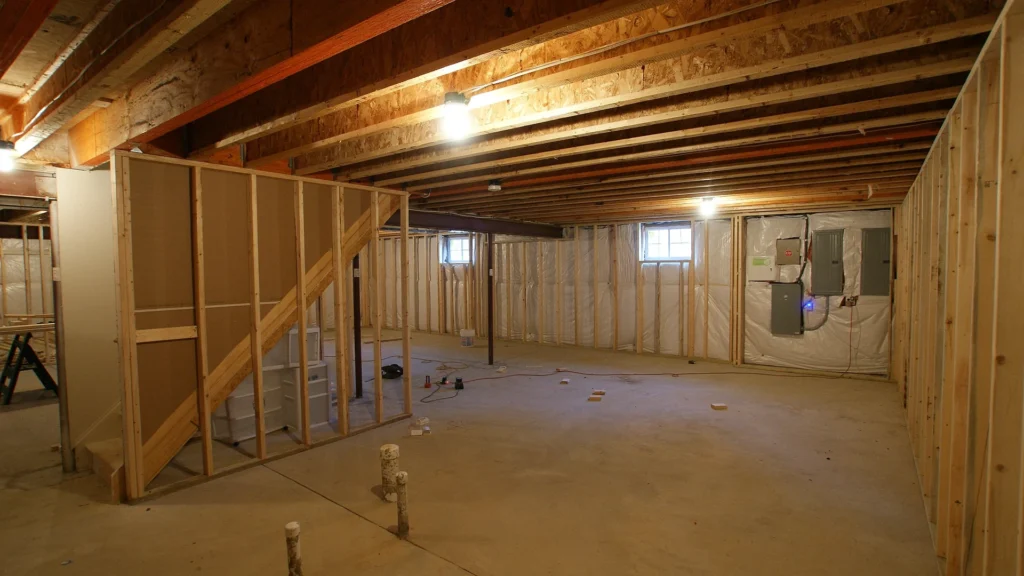
The first choice is to work from below, because then the carpet is never touched. Where the basement ceiling under the room is open, one person walks the noisy spot while another listens below and marks it. The gap between the top of the joist and the underside of the subfloor is then closed with glued shims, a bead of construction adhesive along the seam, or a cleat screwed to the side of the joist tight under the subfloor. Any screw driven upward is sized to stop at least 1/4 inch short of the floor surface, so its tip cannot come through into the carpet.

Where the ceiling below is finished, or the room sits over another room, the repair goes through the carpet. The joist is found first, by measuring across from a joist that can be seen at a heat register or from below, and confirming it with a test screw, because a fastener that misses the joist does nothing. A scored screw is driven through a depth-control fixture pressed into the carpet, then snapped off at the score, below the surface. Several go in along the joist, about 4 inches apart, the spacing one kit maker gives in its instructions. In loop pile, the fibres around the screw are protected so the threads cannot snag a loop and pull a run.

Old hardwood under the carpet changes the method. Through-carpet snap-off kits are made for carpet over plywood or particleboard subfloor, and one maker states that its screw is not designed to find the joist under hardwood. In that case the joist is located by measurement and the fastener is chosen for the extra layer. A squeak that persists after refastening points to something other than a loose connection, and the floor is opened up to find it.

What carpet changes about the repair

In most carpeted rooms the squeak can be fixed with the carpet in place. These are the details that decide how.

No finish to match

There is no stain, grain or sheen to blend, which is what makes a from-above repair through hardwood slower and more visible.

Cut pile hides a small entry

The pile closes over a small entry point. Short, tight or looped carpet hides it less completely, and we say so before starting.

Tack strips and stretch left alone

Because the carpet is never lifted, the perimeter tack strips and the stretch stay exactly as the installer left them.

Hardwood under the carpet

Many older homes have carpet over the original hardwood. That extra layer changes the fastener and how the joist is found, so we check for it first.

When the carpet does come up

A soft or water-damaged subfloor, or squeaks across the whole room, need the subfloor exposed. So does a carpet due for replacement, since the work is easier with it up.

How we fix a squeak under carpet

Find the moving spot and the joist

The squeak is pinpointed by walking and listening, and the joist under it is located and confirmed before anything is driven.

Below if we can, through the pile if not

With an open ceiling below, the gap is shimmed, glued or cleated from the basement. Otherwise the subfloor is drawn down to the joist through the carpet.

Close the pile and walk it again

Snapped-off screws sit below the surface, the pile is worked back over each entry, and we walk the area with you.

What under-carpet squeak repair typically costs

$200 to $1,100 is a typical budgeting range for this kind of work. Where a job falls in it depends mostly on how many spots need work, whether they can be reached from below, and whether there is hardwood under the carpet. Your written quote counts the spots after the diagnostic visit.

Our Process

From your call to a quiet carpeted floor

1

Tell us where it squeaks

Roughly where in the room, whether it is one spot or a line across the floor, and whether the ceiling below is open or finished.

2

We check the carpet and what is under it

Pile type, the age of the carpet, whether old hardwood lies beneath it, and whether you plan to replace it soon.

3

Written quote by spot

Each spot, the method for it (from below or through the pile) and the price, confirmed before anything starts.

4

Refastened and walked again

We refasten, work the pile back over each entry point, and walk the floor with you.

What customers said about loose and squeaking floors

5/5

We hired them to fix squeaking and movement in our hardwood floor. They identified the underlying problem quickly and completed the repair without needing to replace the entire floor. Everything now feels solid and quiet.

Jennifer

Direct Client

5/5

We needed an urgent flooring repair after several boards became loose and uneven. The team responded quickly, secured the boards, and corrected the uneven sections. Professional service and a high-quality repair from start to finish.

Robert

Direct Client

5/5

They repaired several damaged hardwood boards in our living room and blended the replacements beautifully with the existing floor. The team was punctual, tidy, and careful throughout the job. You can barely tell where the damage was.

Michael

Direct Client

Squeaky floor repair under carpet questions

Will fixing the squeak damage or mark our carpet?

It should not. The entry point is small and in cut-pile carpet the pile closes over it, which is why carpet is a more forgiving surface for this work than hardwood. We check the finished area with you before leaving. If your carpet is a very short, tight or looped construction we will say so upfront, because those hide an entry point less completely than a cut pile, and loop pile needs its fibres protected so a loop cannot be pulled.

Would it be better to lift the carpet and do it properly?

Lifting the carpet does not make the repair more thorough, only more disruptive. The repair itself is the same either way: the subfloor is drawn back down to the joist. Lifting means dealing with tack strips, re-stretching and the risk of not getting the carpet back as tight as it was. The exceptions are a soft or water-damaged subfloor, which has to be exposed and cut out, and a carpet you are replacing anyway. Fitting new carpet is a carpet installer's job; we repair the floor under it.

Can you fix a squeak under carpet on stairs as well?

Carpeted stairs are a different job and usually a harder one, because a stair squeak is a loose tread or wedge rather than a subfloor connection, and reaching it through carpet on a stair is more awkward than on a flat floor. It is often possible, but we would want to see it before committing to an approach.

Does the underlay affect whether this works?

Only slightly. Standard foam or rubber underlay compresses under the fastener without causing a problem, and a very thick or dense underlay adds a little depth to work through, which we account for. Old hardwood left under the carpet matters more, because through-carpet snap-off kits are not designed to find a joist under hardwood, so the fastener and method are chosen to suit. What matters most is knowing exactly where the joist is, because a fastener that misses it achieves nothing regardless of what is above it.

Our carpet is over a concrete slab. Is that the same?

No, and it changes things considerably. Carpet laid straight onto concrete has no joists and no wood to rub, so on its own it rarely squeaks. When a carpeted floor over a slab does squeak, there is usually a wood layer in between: subfloor panels or sleepers laid over the concrete that have lost contact with it and move underfoot. There is no joist to fasten into, so the repair is made at that panel or sleeper layer instead. We would look at it before quoting, because the diagnosis is different.

We tried a through-carpet squeak kit and the floor still squeaks. Why?

These are the reasons we check for. The screws missed the joist, so they hold nothing. There is hardwood under the carpet, which those kits are not made for. The noise is not the subfloor at all but a duct, pipe or wire rubbing on a joist below. Or the floor has a support problem, such as a cracked or undersized joist, or a subfloor softened by an old leak, which no screw from above will solve. One kit maker's own instructions say a squeak that persists may be structural or water damage. At the free diagnostic visit we find which it is before quoting.

Squeak under the carpet you would rather not lift?

Get a free written quote to fix the subfloor connection with the carpet left in place, from below where we can.

Back to top