Toronto office on Sheppard Ave E Serving Toronto Free written quotes

Squeaky floor repair in Toronto

Squeaky Floor finds and fixes the loose board, fastener or subfloor connection making the noise in Toronto homes. In the 2021 census, 340,185 Toronto households lived in homes built in 1960 or earlier, when subfloors were nailed down rather than glued.

Get a Free Quote for Your Home

Tell us about your project and we will get back to you within 24 hours.

What can we help with?

So the right crew reviews your project.

No obligation. We reply within one business day.

Toronto housing, by the census

Why so many Toronto floors squeak

Toronto floors squeak because so much of the city’s housing is old. In the 2021 census, 29 per cent of Toronto’s 1,160,895 private households lived in homes built in 1960 or earlier and 58 per cent in homes built in 1980 or earlier, while about a quarter lived in homes built after 2000 (City of Toronto 2021 Census Backgrounder, Table H.1). Across the rest of the Greater Toronto and Hamilton Area, the 1960-or-earlier share is 12 per cent, less than half Toronto’s.

The same backgrounder shows the other side: 353,215 Toronto dwellings, 30 per cent, are condominiums, against 16 per cent in the rest of the GTHA. A high-rise condominium sits on a concrete slab, so a noise there comes from the flooring or its underlay rather than a joist. The joist-and-subfloor squeaks we repair from the basement or through the floor are in Toronto’s houses, semis and row houses.
Three Toronto build eras, three kinds of floor

Before 1914: plank subfloor

Victorian and Edwardian streets such as Riverdale, annexed in 1884, and Roncesvalles, built from 1900 to the First World War. Strip hardwood over plank subfloor.

1910s to 1930s: streetcar suburbs

The Danforth, Birch Cliff and East York's first wave after the 1918 viaduct. Still the plank era, now about a century old.

1950s and 1960s: postwar suburbs

Scarborough doubled from 48,000 to 110,000 people between 1950 and 1955; Don Mills went up from 1952 to 1965. Nailed plywood subfloor.

From one of our repairs

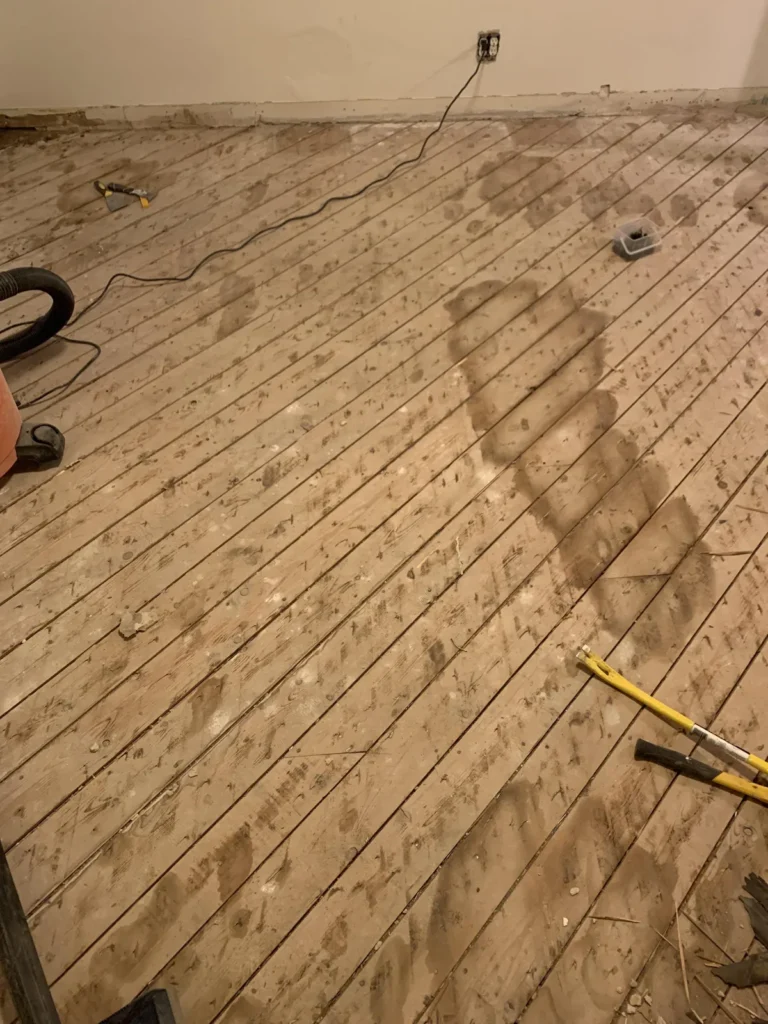
Plank subfloor laid bare

With the finished flooring lifted, this room is down to its plank subfloor: rows of boards nailed across the joists, with the old nail heads still showing. Many Toronto houses built before 1914 sit on this same plank layer, and a loose board in it is refastened to the joist below rather than covered over.

What to know before booking a Toronto repair

A Toronto office on Sheppard Avenue East

Our Toronto office is at 4544 Sheppard Avenue East in Agincourt South-Malvern West. It is an office, not a showroom, and visits are by prior arrangement only.

The whole amalgamated city

The old City of Toronto and the former municipalities joined in 1998: Etobicoke, North York, Scarborough, York and East York.

Repair only

We repair squeaks, stairs and subfloors. We do not install, sand, refinish or sell flooring, so there is no new floor to sell you.

Free visit, written quote

The diagnostic visit is free, and scope and price are agreed in writing before any work begins.

Our Toronto office

Book a free diagnostic visit through our Toronto office at 4544 Sheppard Avenue East in Agincourt South-Malvern West. The crew comes to your house for the visit and the repair.

Toronto Squeaky Floor Repair Pricing

These are budgeting ranges; your written quote sets the price. In a Toronto house the biggest factor is access. A main-floor squeak over an unfinished basement can usually be fixed from below and sits toward the low end. A squeak in an upstairs bedroom, over a finished plaster or drywall ceiling, usually means working from above and costs more.

Diagnostic Visit

Free

We find the board, panel or tread that is moving
We check what access the basement gives
No obligation to book

Request a Visit

Whole-Room or Subfloor Work

$1,000 to $3,500 typical

Several rooms, or a plank subfloor to refasten
Work from above where ceilings are finished
Scope and price in writing first

Get a Free Quote
Our Process

How a Toronto squeak gets found and fixed

1

Tell us the house and the spot

The street, roughly when the house was built if you know, and where you hear the noise. A 1910s semi and a 1990s house point to different causes.

2

We place the squeak

On the free visit we walk the floor and check it from below, to pin the noise to a joist, a subfloor seam or a stair tread.

3

Written quote, access spelled out

Scope and price in writing, including whether the repair is made from the basement with shims, blocking and screws, or from above with trim-head screws.

4

We fix it and walk it again

Once the connection is tight we walk the section again to confirm it is quiet, and show you what was moving.

Reviews of our squeak and board repairs

5/5

We hired them to fix squeaking and movement in our hardwood floor. They identified the underlying problem quickly and completed the repair without needing to replace the entire floor. Everything now feels solid and quiet.

Jennifer

Direct Client

5/5

We needed an urgent flooring repair after several boards became loose and uneven. The team responded quickly, secured the boards, and corrected the uneven sections. Professional service and a high-quality repair from start to finish.

Robert

Direct Client

5/5

They repaired several damaged hardwood boards in our living room and blended the replacements beautifully with the existing floor. The team was punctual, tidy, and careful throughout the job. You can barely tell where the damage was.

Michael

Direct Client

Toronto squeaky floor questions

Why do Toronto homes squeak more than homes elsewhere in the GTHA?

Age of stock, mostly. In the 2021 census, 29 per cent of Toronto households lived in homes built in 1960 or earlier, more than double the 12 per cent across the rest of the Greater Toronto and Hamilton Area. Houses of that age sit on nailed plank or early plywood subfloor, which loosens over decades of seasonal movement in a way that glued and screwed construction does not to the same degree.

Which parts of Toronto does Squeaky Floor cover?

The old city and the former municipalities that joined it in 1998: the downtown east and west neighbourhoods, plus Etobicoke, North York, Scarborough, York and East York. If you are near the edge of the city it is still worth asking rather than assuming we do not come out that way.

Does Squeaky Floor fix squeaks in Toronto condominiums?

Sometimes, but the repair is different. Thirty per cent of Toronto dwellings are condominiums, and in a high-rise the floor is a concrete slab, so there is no joist or subfloor to refasten. Noise there comes from the finished flooring or the underlay, and any work is also subject to the condominium's own rules. Townhouse condominiums with wood framing are repaired the same way as a house.

Is a squeaky floor in a Toronto house a sign of a structural problem?

Usually not. Most squeaks are a fastening and friction issue: a board free to move slightly against a nail, or a subfloor panel that is not sitting tight on a joist. If we find something on site that points to a larger structural issue, such as a cracked joist or a sagging beam, we tell you plainly, but that is the exception.

Tell us where your Toronto floor squeaks

Say roughly when the house was built and where you hear it. The diagnostic visit is free, and the price comes in writing before any work.

Back to top