Yonge Street splits Thornhill by age
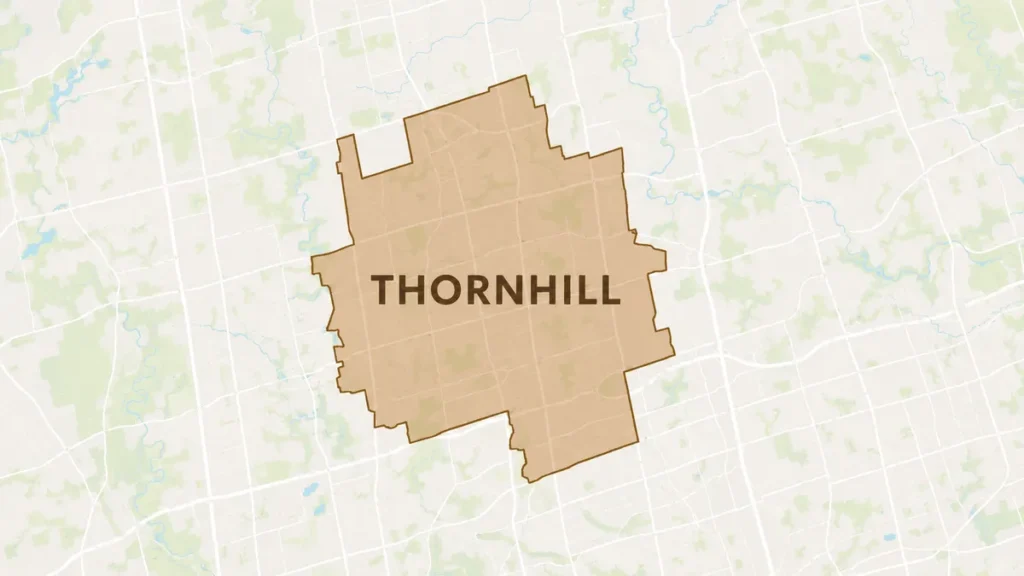
Thornhill’s founding date says little about your floor; which side of Yonge Street you live on says more. The village was settled from 1794 by the first Yonge Street settlers, had mills on the Don by 1802, and was a police village from 1931 to 1971, when its administration reverted to Markham and Vaughan. The old village survives as two heritage conservation districts: 82 properties on the Vaughan side, and the Markham-side district approved in 1986, Markham’s first. Around it, the two halves grew at different times. In the 2021 census, the L3T postal area (Thornhill East, in Markham) had 19,830 occupied dwellings, 44.2 per cent built from 1961 to 1980 and 17.5 per cent in the 1980s. The L4J area (Thornhill West, in Vaughan) had 26,250, only 9.0 per cent built before 1981, 33.7 per cent in the 1980s and 36.4 per cent in 2001 or later (Statistics Canada, 2021 Census Profile). Thornhill Woods is part of that newer share: it is Vaughan’s Block 11, whose block plan went to committee in August 2003. So an east-side house typically sits on nailed plywood 45 to 65 years old, a west-side house on sheet subfloor 25 to 45 years old, and a squeak in Thornhill Woods is more likely a construction detail than wear.