1910s to 1930s homes Serving Danforth Free written quotes

Squeaky floor repair in Danforth

Squeaky Floor finds and fixes the loose board, fastener or subfloor connection making the noise in homes along the Danforth. The Danforth developed from the 1910s through the 1930s as a streetcar suburb, and most of the housing on the side streets north and south of the avenue still dates from that period.

Get a Free Quote for Your Home

Tell us about your project and we will get back to you within 24 hours.

What can we help with?

So the right crew reviews your project.

No obligation. We reply within one business day.

Streetcar suburb, 1910s to 1930s

The Danforth: a streetcar suburb built in one window

Most houses on the Danforth’s side streets share one generation of floor, because they went up in the same few decades. The area developed from the 1910s through the 1930s as a streetcar suburb along the Danforth line, and the Prince Edward Viaduct linked the Danforth to Bloor Street in 1918; at the east end, the Town of East Toronto, a Grand Trunk Railway yard town, had been annexed to the city in 1908. On 26 February 1966 the Bloor-Danforth subway replaced the streetcar on Bloor and Danforth between Keele and Woodbine (TTC Coupler archive). The era-typical floor is strip hardwood over nailed plank subfloor.

The exceptions are easy to place. In the 1960s and 1970s apartment towers went up at Crescent Town, north of Danforth at Victoria Park, and at the Main Square complex south of Danforth at Main Street, and those stand on concrete floors, not joists. On the avenue itself, two-storey main street buildings line most of the frontage between Coxwell and Victoria Park (City of Toronto, Danforth Avenue Urban Design Guidelines).
What we fix in homes along the Danforth

Original strip hardwood

Narrow original boards, refastened in place rather than lifted and replaced.

Bedrooms over the front room

In a two storey house the upstairs floor is the ceiling of the room below, so a loose board upstairs is heard downstairs.

Plank subfloor near a century old

Boards nailed across the joists in the 1910s to 1930s, never designed to be re-tightened.

From one of our repairs

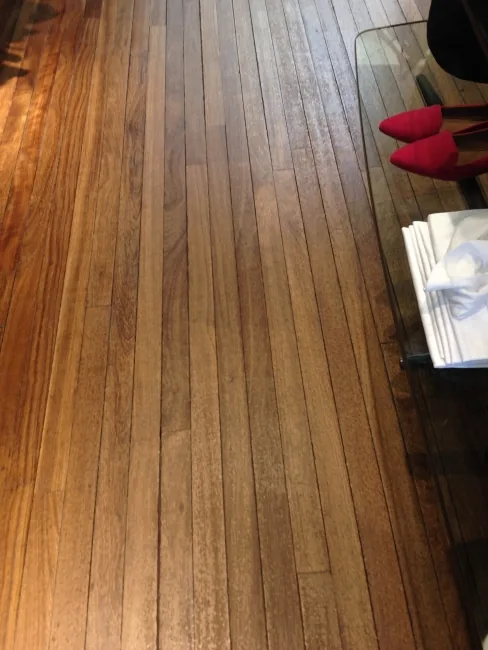
Original strip hardwood, kept in place

This narrow strip hardwood is the kind laid in many houses along the Danforth. A squeak in a floor like this is fixed from above with a screw that is countersunk and filled, so the original boards stay where they are.

How we handle a repair along the Danforth

Repairs from below where possible

Where the basement ceiling is open, we fix from underneath and leave the hardwood alone.

We test the repair before we leave

Walking the section again to confirm the noise is gone.

No upselling

One squeak is one repair, and the quote says so.

Free written quote

Scope and price up front, with no obligation to book.

Our Toronto office, serving the Danforth

Our Toronto office is at 4544 Sheppard Avenue East in Agincourt South-Malvern West. Call to book a free diagnostic visit, and the crew comes to your house along the Danforth for the visit and the repair.

Danforth Squeaky Floor Repair Pricing

These are budgeting ranges; your written quote sets the price. Because so many Danforth houses share one floor assembly, a main-floor squeak over an open basement typically lands in the single-squeak tier. An upstairs bedroom over a finished ceiling, or plank subfloor loose across a room, moves it toward the whole-room tier.

Diagnostic Visit

Free

We find the plank and the nail that moved
We check for renovations that changed the floor
No pressure to book anything after

Request a Visit

Whole-Room or Subfloor Work

$1,000 to $3,500 typical

An upstairs room worked from above
Or plank loose across a whole floor
Quote in writing before anything begins

Get a Free Quote
Our Process

How a Danforth squeak is found and fixed

1

Tell us the street and the room

Which side of the avenue, which floor, and whether the basement is finished. On these streets that usually tells us how we will reach the floor.

2

We find the moving board

On the free visit we locate the squeak above, then check the planks and joists below for the board that has worked loose on its nails.

3

A written price, basement or upstairs

Scope and price in writing, including whether we work from the basement or lift a board upstairs.

4

We refasten the plank and test it

We refasten the plank to the joist, walk the section to confirm the noise is gone, and explain what caused it.

In our customers' words

5/5

We hired them to fix squeaking and movement in our hardwood floor. They identified the underlying problem quickly and completed the repair without needing to replace the entire floor. Everything now feels solid and quiet.

Jennifer

Direct Client

5/5

We needed an urgent flooring repair after several boards became loose and uneven. The team responded quickly, secured the boards, and corrected the uneven sections. Professional service and a high-quality repair from start to finish.

Robert

Direct Client

5/5

They repaired several damaged hardwood boards in our living room and blended the replacements beautifully with the existing floor. The team was punctual, tidy, and careful throughout the job. You can barely tell where the damage was.

Michael

Direct Client

Danforth squeaky floor questions

Most Danforth houses seem the same age. Does that make the repair cheaper?

It can make the diagnosis faster, which may show up in the quote. When the housing on a stretch of street was all built in the same few decades, the floor assembly is consistent and the likely cause is easier to predict. We still confirm it on site rather than assuming, because individual houses have been renovated in individual ways.

Why did so many houses along the Danforth go up at the same time?

Transit. The Danforth grew as a streetcar suburb along the Danforth line, and the Prince Edward Viaduct, opened in 1918, tied it to the rest of the city. The side streets filled in from the 1910s through the 1930s, so neighbouring houses tend to share the same floor construction, with the 1960s and 1970s apartment towers and newer infill as the main exceptions.

Does a 1910s house on the Danforth have a different subfloor from a 1930s one?

Usually not in a way that changes the repair. Both were built before plywood became the standard subfloor after the Second World War, so both are likely to have plank subfloor: 1×6 or 1×8 boards, commonly laid diagonally across the joists. The squeak comes from a board working loose on its nails. What does differ from house to house is later work, such as a refinished floor, a new kitchen or a wall taken out, and we check for that during the diagnosis.

Have a squeak in your home along the Danforth?

Tell us the street and which floor is noisy. The visit is free, and the price is set in writing before any work.

Back to top